
Earthquake zones in Eastern Canada
Background on earthquakes in eastern Canada
The continual shifting of large segments of the earth's crust, called tectonic plates, causes more than 97% of the world's earthquakes. Eastern Canada is located in a stable continental region within the North American Plate and, as a consequence, has a relatively low rate of earthquake activity. Nevertheless, large and damaging earthquakes have occurred here in the past and will inevitably occur in the future.
Rate of Activity
Each year, approximately 450 earthquakes occur in eastern Canada. Of this number, perhaps four will exceed magnitude 4, thirty will exceed magnitude 3, and about twenty-five events will be reported felt. A decade will, on average, include three events greater than magnitude 5. A magnitude 3 event is sufficiently strong to be felt in the immediate area, and a magnitude 5 event is generally the threshold of damage. The seismograph network of Earthquakes Canada can detect all events exceeding magnitude 3 in eastern Canada and all events magnitude 2.5 or greater in densely populated areas.
Causes
The causes of earthquakes in eastern Canada are not well understood. Unlike plate boundary regions where the rate and size of seismic activity is directly correlated with plate interaction, eastern Canada is part of the stable interior of the North American Plate. Seismic activity in areas like these seems to be related to the regional stress fields, with the earthquakes concentrated in regions of crustal weakness.
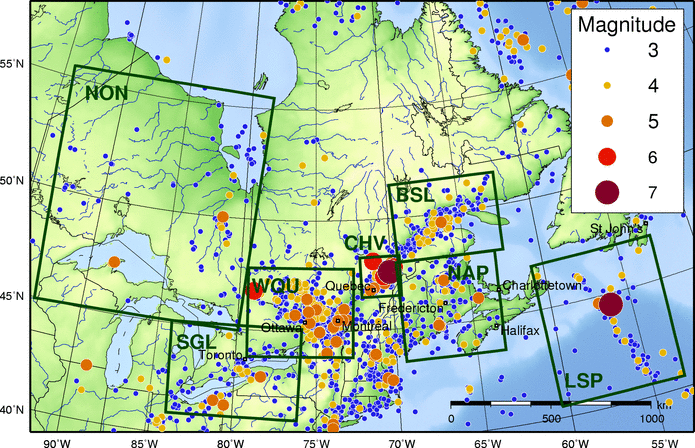

Although earthquakes can and do occur throughout most of eastern Canada, years of instrumental recordings have identified certain clusters of earthquake activity. In these clusters, earthquakes occur at depths varying from surface to 30 km (the deepest mine in Canada is 2 km deep). More information is available on the historical seismicity of the following regions in Eastern Canada:
- Eastern Northern Ontario
- Southern Great Lakes
- West Quebec
- Charlevoix-Kamouraska
- Lower St. Lawrence
- Northern Appalachians
- Laurentian Slope
Northeastern Ontario Seismic Zone
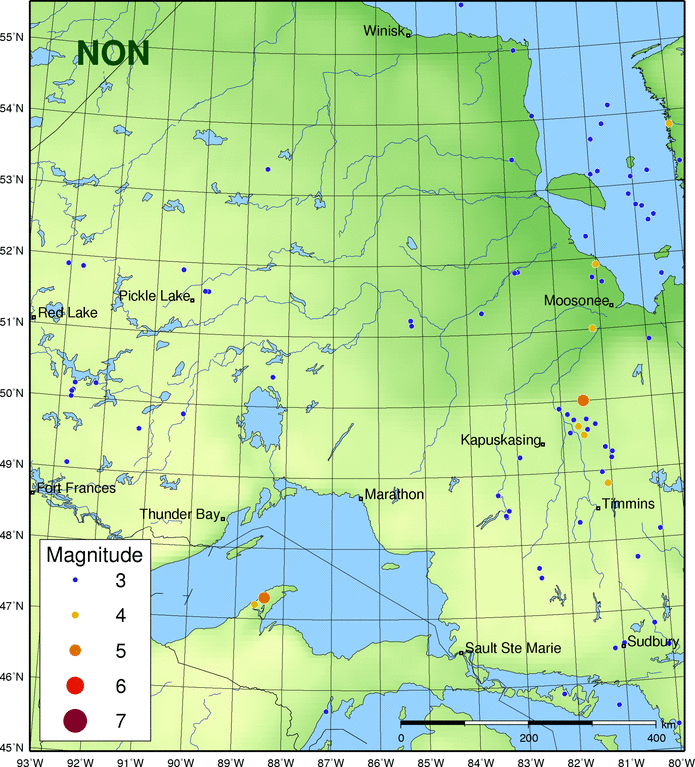
Northern Ontario has a very low level of seismic activity. From 1970 to 1999, on average only 1 or 2 magnitude 2.5 or greater earthquakes have been recorded in this large area. Two magnitude 5 earthquakes (1905, northern Michigan, and 1928, northwest of Kapuskasing) have occurred in this region.
Southern Great Lakes Seismic Zone
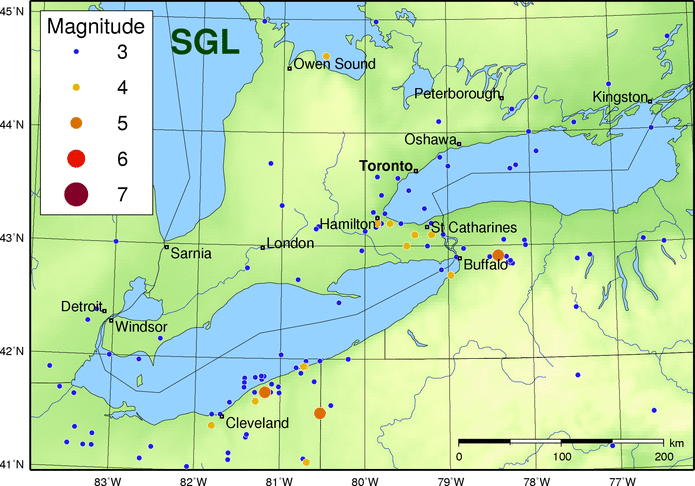
This region has a low to moderate level of seismicity when compared to the more active seismic zones to the east, along the Ottawa River and in Quebec. Over the past 30 years, on average, 2 to 3 magnitude 2.5 or larger earthquakes have been recorded in the southern Great Lakes region. By comparison, over the same time period, the smaller region of Western Quebec experienced 15 magnitude 2.5 or greater earthquakes per year.
Three moderate sized (magnitude 5) events have occurred in the 250 years of European settlement of this region, all of them in the United States - 1929, Attica, New York, 1986, near Cleveland, Ohio, and 1998, near the Pennsylvania/Ohio border. All three of these earthquakes were widely felt in southern Ontario but caused no damage in Ontario.
Western Quebec Seismic Zone
The Western Quebec Seismic Zone constitutes a vast territory that encloses the Ottawa Valley from Montreal to Temiscaming, as well as the Laurentians and the Eastern Ontario. The urban areas of Montreal, Ottawa-Hull and Cornwall are located in this zone.
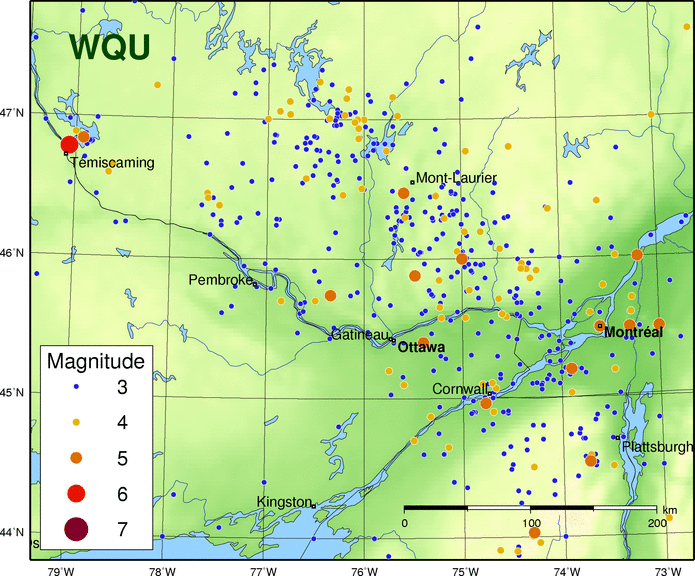
The pattern of historical seismic activity recorded by the Canadian seismograph network since the beginning of the century shows the earthquakes concentrating in two sub-zones: one along the Ottawa River and the second along a more active Montreal-Maniwaki axis.
Historical Seismicity
The Western Quebec Zone was the site of at least three significant earthquakes in the past.
- In 1732, an earthquake estimated at 5.8 on the Richter scale shook Montreal, causing significant damage.
- In 1935, the area of Temiscaming was shaken by an earthquake of magnitude 6.2.
- In 1944, an earthquake of magnitude 5.6, located between Cornwall, Ontario and Massena, N.Y., caused damage evaluated at two million dollars of the time.
From time to time, the area is also shaken by weaker earthquakes felt by the local population.
- In 1990, an earthquake of magnitude 5 took place near Mont-Laurier, Quebec.
- In 1996 and 1997, two earthquakes of magnitude 4.4 and 4.3 occurred near Ste-Agathe-des-Monts, Quebec.
An earthquake occurs in the Western Quebec Seismic Zone every five days on average.
More Information
- View seismicity during the last 30 days.
- Research papers describing the geological, geophysical and seismological characteristics of the seismic zone.
Charlevoix Seismic Zone
Located some 100 km downstream from Quebec City, the Charlevoix Seismic Zone (CSZ) is the most seismically active region of eastern Canada. As most earthquakes occur under the St. Lawrence River, between Charlevoix County on the north shore and Kamouraska County on the south shore, this region is also often referred to as the Charlevoix-Kamouraska Seismic Zone.
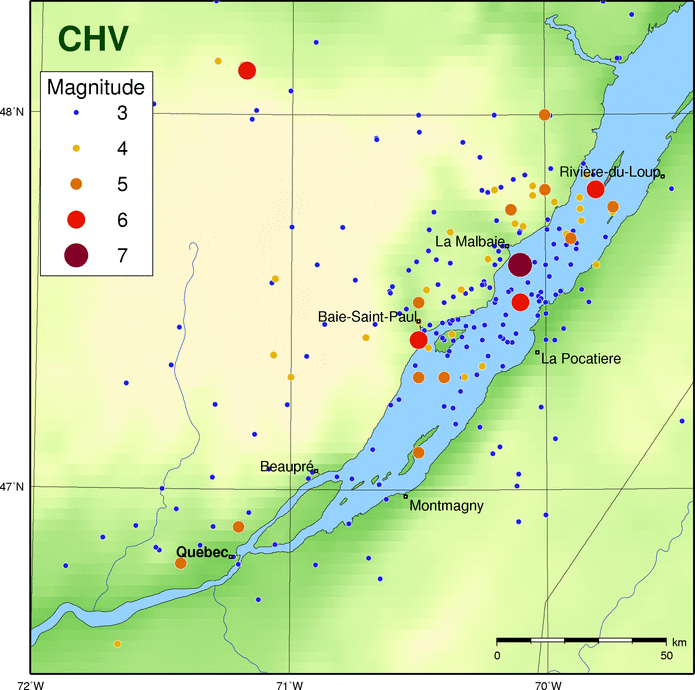
Historically, the zone has been subject to five earthquakes of magnitude 6 or larger: in 1663 (Mag. 7); 1791 (Mag. 6); 1860 (Mag. 6); 1870 (Mag. 6 1/2); and 1925 (magnitude MS 6.2 ± 0.3). Since the 1925 event was the only one recorded by seismographs, the previous events have approximate magnitudes evaluated using felt areas and damage. Similarly, pre-instrumental locations of events are less precise. Overall, the distribution of historical and recent events shows an earthquake concentration between La Malbaie and Rivière-du-Loup.
The earthquake potential of the CSZ led the GSC to conduct two field surveys in 1970 and 1974. These two surveys clearly delineated the CSZ to be an active zone about 30 by 85 km, elongated along the St. Lawrence River, and enclosing the towns of Baie-St-Paul, La Malbaie and La Pocatière.
Earthquake Hypocentres
Since 1977, a seven-station local seismograph network, centred on the active zone, has monitored the earthquake activity. The current CSZ network detects more than 200 earthquakes per year. Based on historical and current earthquake rates, the CSZ is the zone of highest seismic hazard in continental eastern Canada.
Due to its dense seismograph network, the CSZ is the only eastern Canadian region where the focal depth of earthquakes can be routinely calculated. The hypocentres located over the years have provided an insight into the CSZ seismotectonics.
Most earthquakes cluster along or between the mapped Iapetan faults (also called St. Lawrence paleo-rift faults). CSZ earthquakes occur in the Canadian Shield, between the surface and 30 km depth, beneath Logan's line and the Appalachians.
On average, an earthquake occurs in the Charlevoix region every day and a half.
More information
- View seismicity during the last 30 days.
- publications.
Lower St. Lawrence Seismic Zone
Located some 400 km downstream from Quebec City in the estuary of the St. Lawrence River, the Lower St. Lawrence Seismic Zone (LSZ) is a seismically active region of eastern Canada. As most earthquakes occur under the St. Lawrence River, between the regions of the Quebec North Shore and the Lower St. Lawrence, this zone is sometimes refered to as the "Lower-St. Lawrence-Quebec North Shore" Seismic Zone.
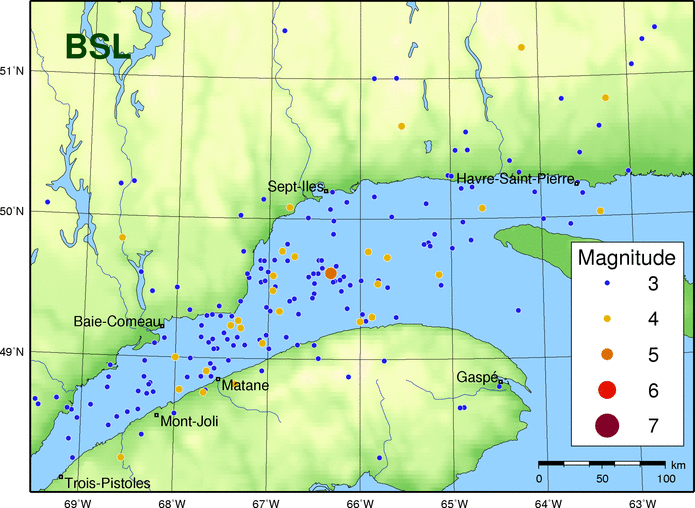
Unlike the Charlevoix Seismic Zone, no large earthquake has ever been reported or recorded in the LSZ. Only two events are known to have exceeded magnitude 5.0. On June 23, 1944, an earthquake of magnitude 5.1 on the Richter scale occurred occurred near Godbout, east of Baie-Comeau. More recently, on March 16, 1999, an earthquake of magnitude 5.1 occurred in this region, at about 60 km south of Sept-Iles.
The region is closely monitored by a network of five local stations of the Canadian National Seismograph Network. With the current network, all earthquakes larger than about magnitude 2 on the Richter scale can be located. Hence, all earthquakes that could be felt (i.e. larger than magnitude 2.5) can be detected by the network and located by the analysts of the Geological Survey of Canada.
About 60 events are recorded in the LSZ annually. Most earthquakes occur under the St. Lawrence River, within a triangular zone defined by the towns of Baie-Comeau, Sept-Iles, and Matane on the south shore.
Although the network is not sufficiently dense to accurately determine earthquake focal depths, it can be assumed that the active zone lies in the mid- to upper crust, between 5 and 25 km depth, similar to the Charlevoix Seismic Zone (CSZ). From some focal mechanism determinations (see references below) and by analogy with the CSZ, most earthquakes probably cluster along or between the mapped Iapetan faults (also called St. Lawrence paleo-rift faults), beneath the Logan's line and the Appalachians.
A Lower St. Lawrence earthquake occurs every five days on average.
More Information
- View seismicity during the last 30 days.
- Research papers describing the geological, geophysics and seismological characteristics of the seismic zone.
Northern Appalachians Seismic Zone
The Northern Appalachians Seismic Zone includes most of New Brunswick and extends into New England down to Boston.
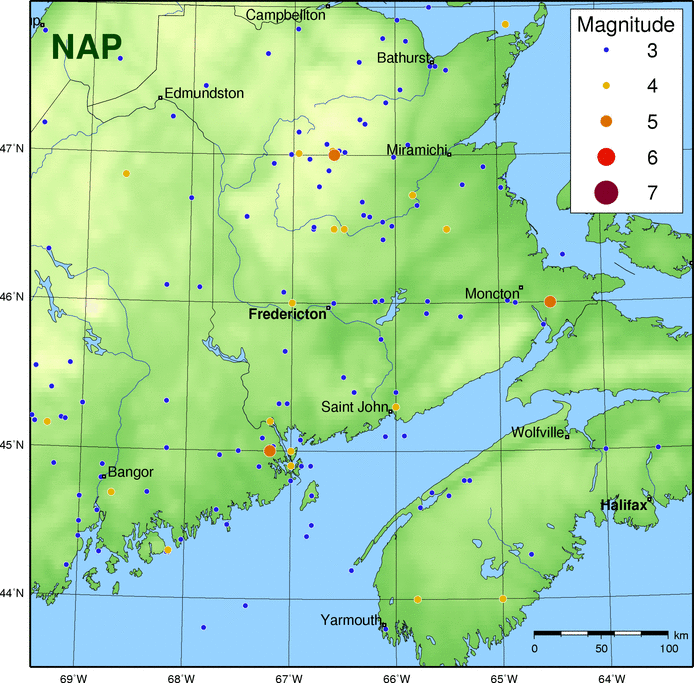
In the Miramichi area of central New Brunswick, a series of significant earthquakes occurred in 1982 (largest M5.7) and was followed by numerous aftershocks thereafter. The zone also witnesses a continuing low level of seismic activity including many larger historic earthquakes in New Brunswick.
Laurentian Slope Seismic Zone
The Laurentian Slope Seismic Zone comprises an area off Canada's southeast coast, which includes the Grand Banks of Newfoundland.
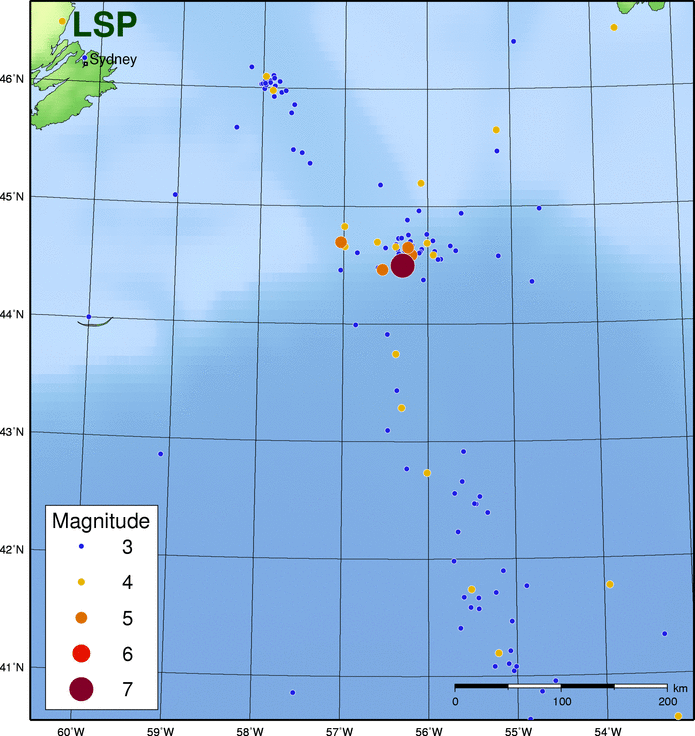
In 1929 a large M7.2 earthquake occurred near the Grand Banks and was responsible for a large tsunami (seismic sea-wave) which tragically drowned 27 people when it came ashore on the Burin Peninsula in southern Newfoundland. This was one of the few incidents involving loss of life in any recorded Canadian earthquake.