
What is a seismologist?
Principal functions
Seismologists are Earth scientists, specialized in geophysics, who study the genesis and the propagation of seismic waves in geological materials. These geological materials can range from a laboratory sample to the Earth as a whole, from its surface to its core.
Their research aims at interpreting the geological composition and structures of the Earth. In the case of earthquakes, seismologists evaluate the potential dangers and seek to minimize their impact through the improvement of construction standards.
The vast majority of seismologists work in petroleum exploration, where the seismic waves come from controlled sources explosions, vibrations caused by trucks).

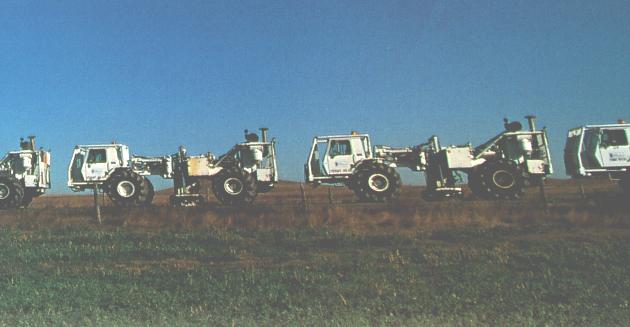
The generated seismic waves make it possible to locate the geological structures at depth. At the Geological Survey of Canada, the Seismology and Electromagnetism Section carries out such research.
Other seismologists study the seismic waves generated by much more powerful sources: natural, like earthquakes and mining events, or artificial, like underground nuclear tests. The fundamental work of a seismologist is to locate the source, the nature, and the size (magnitude) of these seismic events. In Canada, this work is mainly carried out by the seismologists of Earthquakes Canada.
Within the study of earthquakes, several specialities exist. Certain seismologists study the relation between faults, stress and seismicity (i.e. seismo-tectonics), others interpret the mechanisms of rupture from seismic wave data (focal mechanisms), others integrate geoscientific information in order to define zones of seismicity (seismic zoning), and finally others, collaborate with engineers in an attempt to minimize the damage caused to structures (earthquake engineering).
Seismologists work in multidisciplinaryms composed of Earth scientists, technicians and professionals from the fields of computers, physics, electronics, telecommunications and civil engineering. Contacts with emergency organizations are often necessary.

Tools of the seismologist
There is no seismology without seismographs! Seismographs are the key tool of seismologists since they make it possible to collect and to record the vibrations of the Earth. Traditionally, seismographs recorded on paper (analogue recorders). This type of apparatus is becoming much less popular. Nowadays, digital instruments are preferred since they allow better definition of ground vibrations and make readings much more precise.

During field surveys, sometimes made following large seismic events, portable seismographs are deployed in order to increase the number of seismographs in the area of study. If the survey is carried out in remote locations, seismologists may use trucks, planes, or helicopters. The seismologists might even have to sleep under tents!




At all times, the seismologists use computers. These make it possible to record and visualize the movements of the Earth. Specialized software, sometimes developed by the seismologists themselves, makes it possible to interpret the seismological data.

Interests
As with any Earth scientist, curiosity and a thirst for knowledge are essential to the seismologist. Moreover, a meticulous nature, an interest in computer science, and in certain cases, in outdoor activities, are necessary. Though often called upon to work alone, the seismologist must also be able to work within teams to solve problems. Well developed written and oral communication skills are important in order to communicate the results of their research.

Studies
Depending on their field of interest, seismologists can come from following the fields: geology, geophysics, physics or applied mathematics. A university undergraduate degree is necessary, and Masters studies or Doctoral work are significant assets for more advanced research.
Though several Canadian universities offer degrees in Earth sciences (geology, geological engineering, geophysics), none offer programs dealing with the seismology of earthquakes. Specialization can be done at the Graduate level (Masters, Doctorate) after a first degree in the disciplines mentioned above.
Prospects for employment
In Canada, seismologists interested in the study of earthquakes number only a few dozen. The prospects for employment are thus relatively restricted. However, the possibility of recruitment increases according to the level of gen_infoation of the candidates. In Canada, one finds the majority of seismologists at the Geological Survey of Canada, as well as at universities and with several engineering firms.
Other questions?
For information on the trades and professions of the Earth sciences, visit The Canadian Geoscience Council.